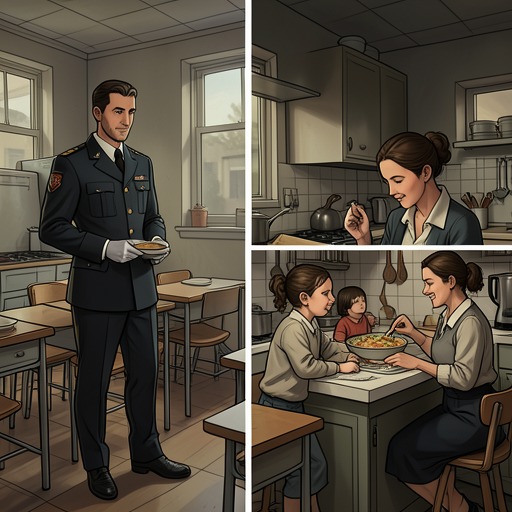
Scott Wallaker
Bridget Jones: Mad About the BoyScott Wallaker enters Bridget Jones’s life as a guarded, capable presence around the school, but the qualities that first make him difficult to read become the foundations of his importance: he is trained for emergencies, attentive to children, and willing to offer care without making it a test of independence. His arc runs from a revealing account of his past, through a rescue in which three boys are trapped beneath a car and fallen fence, to a family life in which Bridget and the children no longer have to manage alone.
Identity and Background
Scott is connected to Bridget through the children’s school and through Jake, with whom he was at college. His military background is not apparent to Bridget at first. When she learns that he went into the Special Air Service, his earlier conduct suddenly seems legible: Billy’s mock-commando commands and rolling from a tree, as well as Scott’s reflex at Sports Day, become clues to training she had not known about. Bridget’s comic leap from the revelation to imagining him as James Bond registers both her surprise and the gap between his ordinary school presence and his extraordinary past.
His relation to music is similarly clarified rather than simply defined. When asked if he is a musician, Bridget first receives a muddled answer: music is a hobby, while his career took him into the Special Air Service. The detail keeps him from being reduced to a single role. He can be associated with music and school life, yet his most decisive actions draw on military training and practical composure.
At the School
Scott’s presence around the school is not limited to the dramatic rescue. In a discussion about Billy, he responds to a teacher’s concern about giggling by saying there is no need to worry too much about it, then redirects the conversation to the English problem. When spelling difficulties are raised, his brief question about whether they are still an issue gives the exchange a direct, child-focused quality. The scene places him among adults discussing the children’s needs, but his attention is not simply to discipline or appearances: he moves the conversation toward the specific difficulty that needs addressing.
That manner contrasts with Bridget’s tendency to turn anxiety into self-reproach. Scott’s school-side role is practical and measured, a quality that matters more as he becomes involved in family life. The account does not present him as a distant rescuer who appears only at moments of danger; it shows him already engaged in the everyday world of the children, where spelling, school behaviour, and parental concern all matter.
The Rescue and Its Aftermath
Scott’s competence becomes unmistakable when a car and the school fence collapse around Billy, Bikram, and Jeremiah. The boys are cowering in the narrow gap beneath a heavy metal post. The fence is buckled and hanging at an angle; the post is wedged diagonally between the pit wall and the ground, while the rear of the car hangs above them. Trapped by the fallen fence at their sides and in front, with the wall behind, the children are left staring terrified at Scott.
Bridget jumps down into the pit, but Scott remains calm and tells her, "I’ve got this." His authority in the moment is grounded in the scene’s physical danger: the children are confined beneath unstable debris, and reassurance must accompany action. The rescue is therefore more than a display of his past training. It is an encounter in which his composure gives Bridget something she cannot provide by herself: confidence that the boys can be reached safely.
Afterward, when he sees Bridget’s face, Scott offers to drive her home. She insists that she is fine, though she is lying. Rather than accept her performance of self-sufficiency, he tells her, "It doesn’t make you less of a top professional feminist if you let somebody help you." The line makes his care unusually precise. He recognises that accepting assistance may feel to Bridget like a contradiction of her independence, and answers that conflict without belittling her or withdrawing the offer. At home, as she settles the children on the sofa, he asks what she needs; she names their cuddly toys, which are upstairs in the bunk beds. His attention moves from danger to the small practical requirement of helping the children feel settled.
Relationship with Bridget
Scott and Bridget’s relationship develops amid the unsettled boundaries of dating, age, and family responsibility. In one exchange, Bridget asks about Miranda, and Scott reacts with disbelief: Miranda is twenty-two and is his brother’s stepdaughter. He clarifies that she had merely bumped into him while shoe-shopping. His response exposes Bridget’s mistaken assumption, while his counterpoint—that she is the one engaged to marry a child—turns the exchange back toward her relationship with the much younger Roxster. The moment is comic, but it also makes the age difference and its social awkwardness explicit.
Scott’s later place in Bridget’s life is not framed as a simple replacement for Mark. By the end, Bridget believes Mark would have wanted them not to remain alone and confused, and would have been glad that, if she found someone, it was Scott. That reflection preserves the emotional presence of Bridget’s late husband while allowing her to form a new partnership. Scott’s significance lies in the care he provides in the present, not in erasing the past.
Family Life and Significance
By the conclusion, Bridget describes a household of six: herself, Scott, and their four children. Billy has older boys to play Xbox with and comes away from the game without arguing about reaching the next level if Scott so much as looks at him. The detail gives Scott a quiet parental authority, effective without a prolonged confrontation. Bridget and Scott also spend weekends with Jake, Rebecca, and the children, so that everyone has someone to play with.
For Mabel, the change is especially pointed. Since she was too young to understand Mark’s death, she has lacked a father who is present in this world; now Scott treats her like a princess, to the point that Bridget has to caution her. The ending links his arrival to a change in the children’s daily security as well as Bridget’s: she says she feels safe, cared for, and no longer lonely.
The family’s home is a large, messy house near Hampstead Heath, from which the children can walk to school. They manage with one car, although they are still late every morning. The practical details keep the new life recognisably imperfect, rather than turning it into a frictionless resolution. The family sometimes visits Capthorpe House and, after the children are in bed, revisits the scene in the bushes with a better ending. Scott’s character arc thus closes not with a grand declaration but with shared domestic arrangements, children gathered into a larger family, and a past scene given a different outcome. His decisive role is to make care tangible: a steady voice in the pit, a ride home offered, toys fetched for the children, and a home in which Bridget no longer has to carry everything alone.